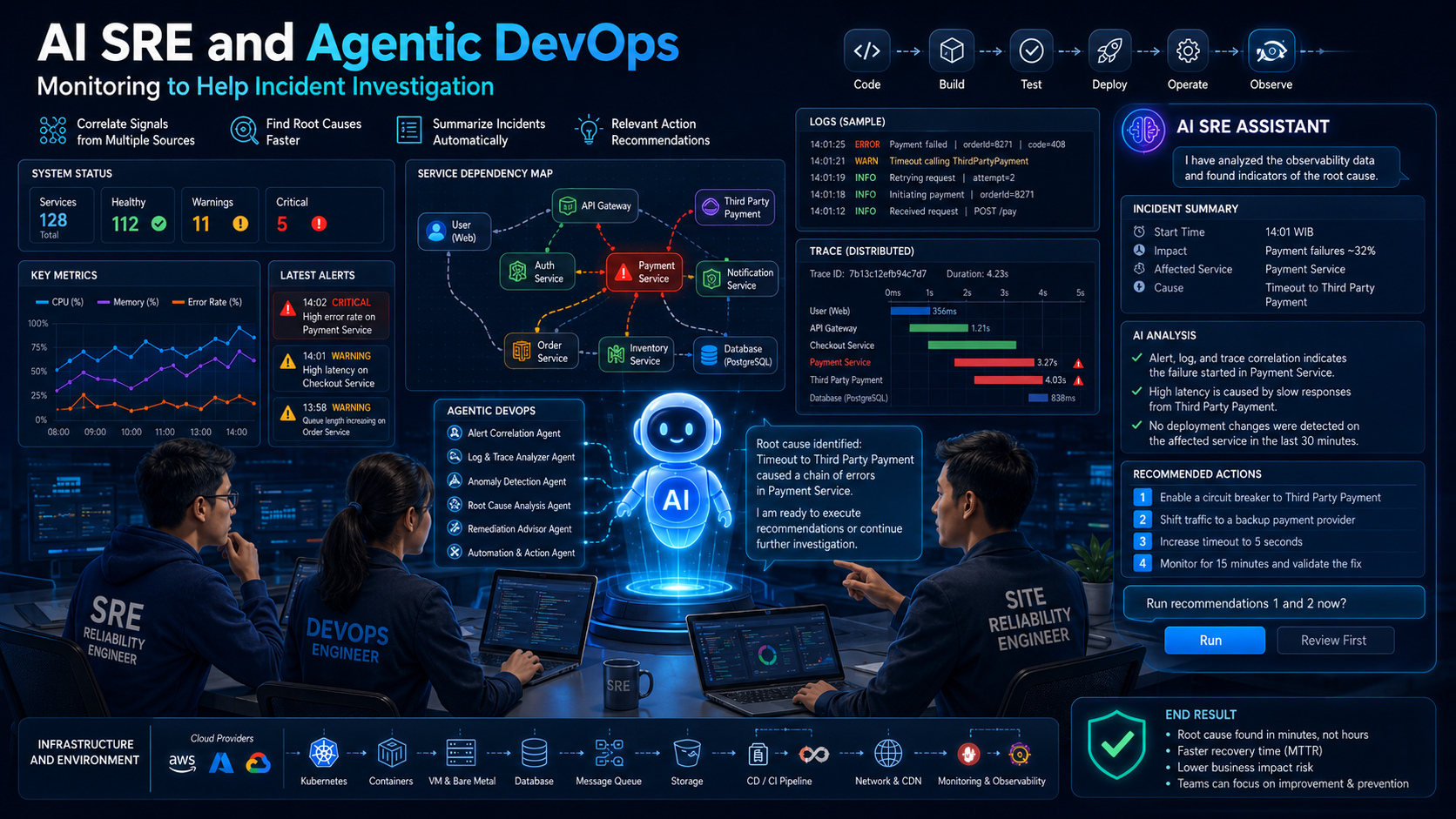
AI SRE and agentic DevOps are becoming common topics in DevOps discussions this year. This is not just about a chatbot answering technical questions. The more useful idea is a system that can read signals from monitoring, logs, deployment history, and configuration, then help a team understand what happened during an incident.
For small teams, MSPs, and managed VPS providers, that matters. Many production issues do not start with something dramatic. A disk slowly fills up. A service keeps restarting. A database query gets heavier. A small configuration change causes trouble a few hours later.
AI will not magically fix all of that. But it can help with the first part of incident response, which is often the slowest part: gathering context.
From alert to investigation
Traditional monitoring usually stops at the alert. CPU is high. Memory is exhausted. HTTP 500 errors are rising. Latency is worse than usual.
The alert tells the team that something is wrong, but the team still has to open dashboards, read logs, check the latest deployment, compare traffic, and form a hypothesis. This is where AI SRE starts to become useful.
A more modern workflow looks like this:
- An alert comes in from the monitoring system.
- AI collects context from logs, metrics, traces, and changelogs.
- The system summarizes when the issue started, which services are affected, and what changed near that time.
- An engineer still decides what to do: rollback, scale up, disable a feature, or investigate further.
That last part matters. In production, AI should not get unlimited permission to change servers. Let it help read the situation first.
Good fit for repetitive operations work
A lot of DevOps work is repetitive, but it still requires care. For example:
- reading error patterns in web server logs;
- comparing service status before and after deployment;
- finding containers that keep restarting;
- checking disk usage, inode usage, queues, and database connections;
- drafting a postmortem after the incident is resolved.
When all of this is done manually, engineers spend too much time on administrative work. With read-only AI assistance, the team can reach the useful questions faster: what changed, who is affected, and what is the safest action?
Guardrails are not optional
The agentic DevOps trend also brings risk. An agent with too much freedom can run dangerous commands, misread context, or make changes that are hard to roll back.
For server operations, a staged model is safer:
- Start with read-only access: logs, metrics, service status, and non-secret configuration.
- Ask AI to summarize and propose options, not execute changes immediately.
- Require human approval for service restarts, rollbacks, migrations, and firewall changes.
- Keep an audit trail: what command was suggested, who approved it, and what happened next.
- Prepare rollback steps before giving automation more room.
With this approach, AI becomes an operations assistant, not a loose operator.
Why this matters for managed VPS and MSP work
For managed VPS providers and MSPs, AI SRE has practical value. One engineer may handle many servers, many applications, and many types of incidents. The goal is not hype. The goal is faster response without weaker judgment.
Useful early use cases include:
- daily server health reports in plain language;
- incident summaries for clients;
- simple anomaly detection from logs and metrics;
- patching priority recommendations;
- pre-deployment and post-deployment checklists;
- SOP updates based on real incidents.
At this level, AI does not replace the sysadmin. It is closer to a junior engineer that reads data very quickly, while a senior person still understands the business context and risk.
Start small
Teams do not need to build a large AI platform on day one. Start with one clear workflow, such as:
- a daily alert summary;
- Nginx and PHP-FPM log analysis;
- disk and backup review;
- a simple postmortem draft after an incident;
- critical service checks after maintenance.
If the results are consistent, expand the access slowly. If the results are not consistent, do not let the system perform production actions.
Closing thoughts
AI SRE and agentic DevOps are gaining attention because operations work is getting more complex. There are more servers, more dependencies, and often the same number of people.
The value is not in the word "AI". The value is in turning scattered operational data into context that helps people make better decisions.
For small and medium businesses, the safest path is to start with observability, reporting, and read-only investigation. More aggressive automation can come later.
If you manage servers, business applications, or VPS services and want a cleaner workflow for monitoring, backup, incident response, and automation, IDDevOps can help design a realistic path: audit first, SOP next, then gradual implementation.